3-in-1 Wireless Charging Stations: A Sourcing Guide for Distributors
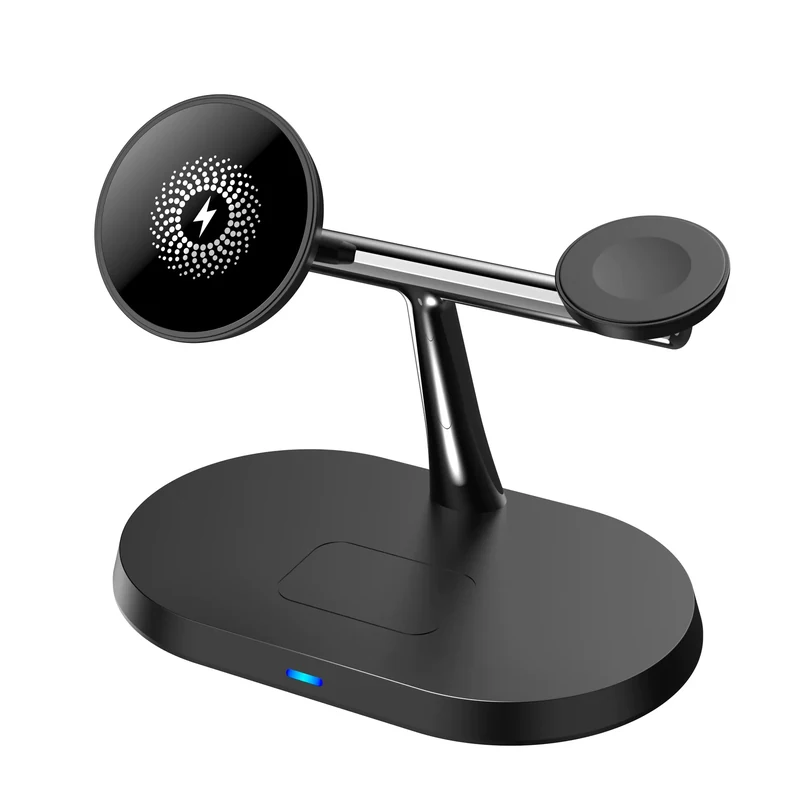
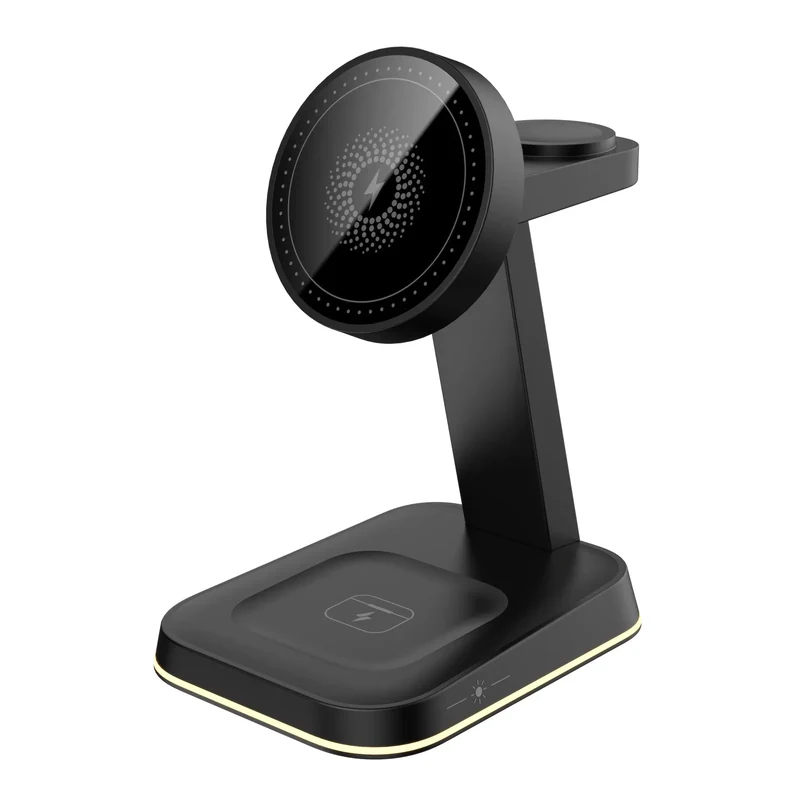
A 3-in-1 station is one power supply feeding three independent charging systems. Its real specification is the input budget and how that budget is divided, plus whether the watch module is compatible with the watch your customers actually own. Before ordering, confirm the total input power and the required adapter, the watch charging module and its compatibility statement, the spacing between coils, whether the design folds flat, and what the packaging claims about simultaneous charging.
Key takeaways
- Total output is capped by the input adapter. A station sold without an adequate adapter underperforms.
- The watch module is the most common compatibility failure, because watch charging is not uniform across brands.
- Coil spacing exists to prevent interference; a compact design can compromise it.
- Claiming simultaneous full-rate charging on all three positions is rarely accurate.
- Foldable designs sell to travel buyers but add a hinge and a wear point.
One supply, three systems
The three positions are not separate chargers in one housing — they share a single input. That creates a budget problem the buyer must understand before writing marketing copy.
A station with a 15W phone pad, a watch module and an earbuds pad might draw on a 30W input. When all three are loaded, the phone position commonly receives less than its standalone maximum, because the watch and earbuds positions take priority for small but continuous draws.
| Input rating | Realistic behaviour when all three positions are loaded |
|---|---|
| Undersized adapter (for example 18W) | Phone position throttles noticeably; dropouts possible |
| Matched adapter (commonly 30W and above) | Phone near maximum, watch and earbuds charge normally |
| Oversized adapter | No benefit beyond the station's own limit |
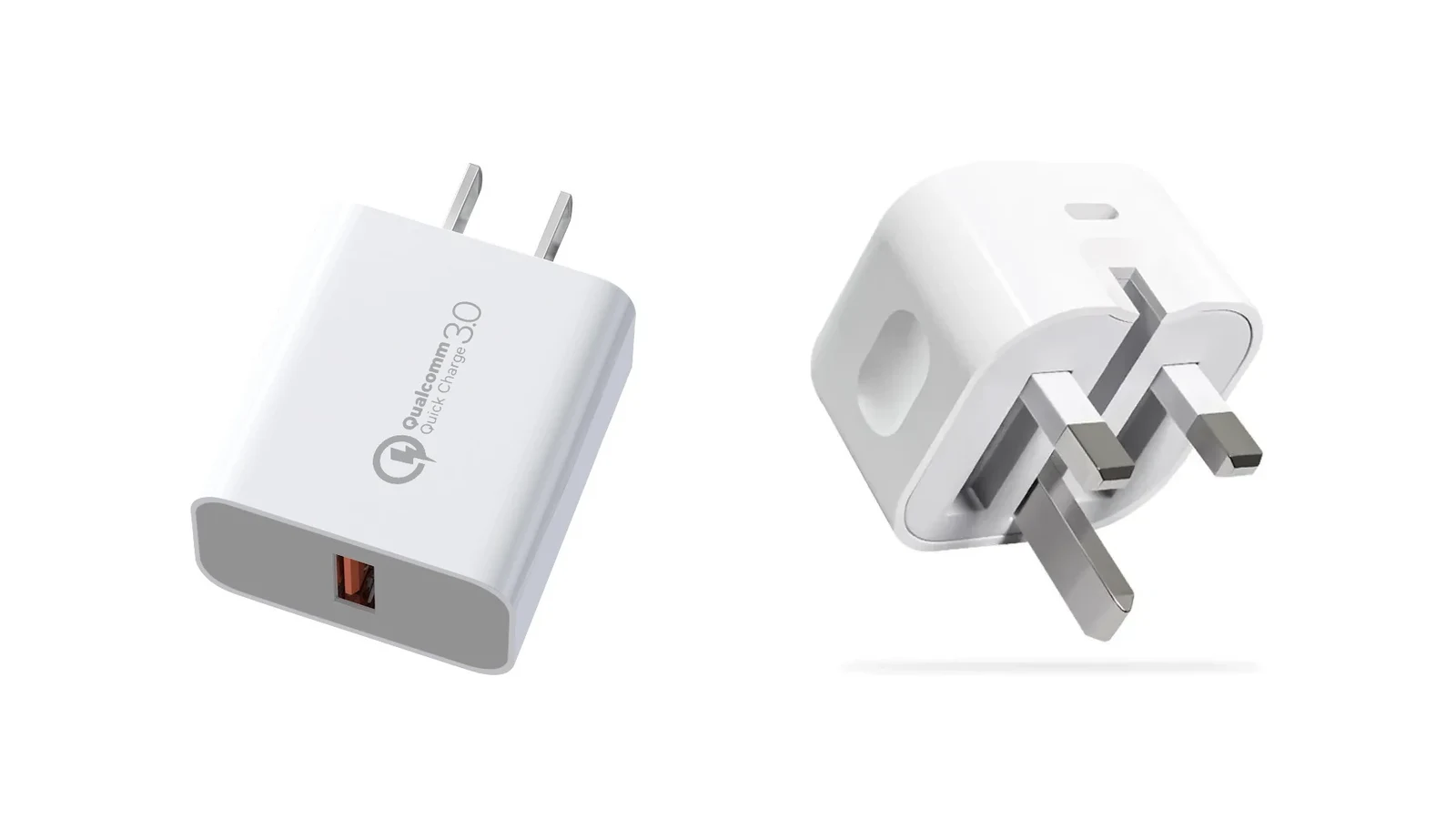
Ask two questions: what input does the station require, and what is the allocation when all three positions are occupied. The answer belongs on the packaging, because a customer using a phone charger from a drawer will otherwise conclude the station is faulty.
The watch module is where compatibility breaks
Phone wireless charging follows widely implemented standards, so alignment and power are broadly predictable. Watch charging does not. Different watch families use different coil geometry, different power levels and, in some cases, proprietary communication between the watch and its charger.
Practical consequences for a sourcing programme:
- Confirm the module type, not just "watch compatible".
- Ask which watch models were tested, and whether charging is at the watch's normal rate or a reduced one.
- Check the licensing position where a proprietary module is involved. A module that requires authorisation and does not have it is a compliance problem, not a cost saving.
- Test with a real watch from the market you are selling into, at low battery, because some watches refuse to start on an underpowered module.
A station sold as "for all smartwatches" that charges one brand at full rate and another at a trickle will generate returns that read as "the watch part doesn't work".
Coil spacing and interference
Three coils in one housing sit close together. Manufacturers space them to limit cross-coupling, which is why compact stations often place the earbuds pad behind or beside the phone pad rather than directly under it.
When evaluating a design, check:
- Whether a phone on the pad interferes with the watch position, and vice versa
- Whether metal objects placed near an unoccupied pad cause the station to heat or stop
- Whether the earbuds pad accepts a case, since earbud cases vary in thickness
- Whether the station warns or shuts down when a foreign object is detected
Foreign object detection is a safety feature, not a marketing one. Its absence shows up as heat and, occasionally, as a damaged case.
Fixed, foldable and stand designs
| Design | Strength | Weakness | Best channel |
|---|---|---|---|
| Flat pad, three positions | Simple, robust, cheapest | Takes desk space, phone lies flat | Desk accessory, gift |
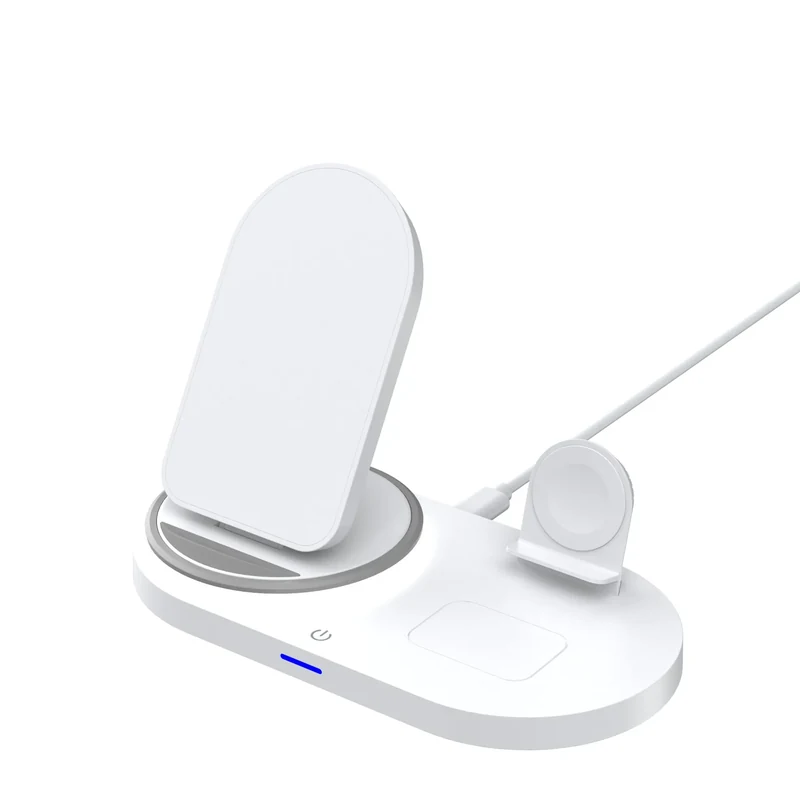
| Stand with watch arm | Phone readable while charging | Taller, more packaging volume | Office, bedside |
| Foldable travel | Compact, good for bags | Hinge wear, alignment drift over time | Travel retail, gifting |
The foldable variant is the most attractive to buyers and the most likely to generate a mechanical complaint after a year of use. If you stock it, ask about hinge cycle rating and test alignment after repeated folding, because a hinge that loosens moves the coil out of position and the symptom is "it stopped charging".
What the packaging should state
Returns in this category are usually caused by packaging promises rather than hardware faults. Four lines prevent most of them:
- The input adapter required, and whether one is included
- The maximum rate at each position, and whether rates change when all three are used
- The watch models tested, stated specifically
- The case conditions required for the phone position
A station that ships without an adapter and does not say so is the single most common source of one-star reviews in this segment.
Verification checklist
- Input voltage and current required; adapter included or not
- Allocation table when one, two and three positions are loaded
- Watch module type, tested models, and licensing position if proprietary
- Phone position rate with a thin case and with a thick case
- Foreign object detection behaviour
- Surface temperature after twenty minutes with all three positions loaded
- Hinge cycle rating, for foldable designs
- Packaging claims matched against measured behaviour
This guide describes how multi-position wireless charging stations allocate power and which compatibility questions determine real-world performance. It does not publish test results for specific SKUs, supplier pricing or certification conclusions. Watch module compatibility and licensing requirements differ by brand and change over time — confirm with the supplier and validate with the watches your market actually sells before committing volume.
Frequently asked questions
Why does the phone charge more slowly when the watch is also on the station?
Because the station divides one input budget across three positions. The watch and earbuds positions take a small but continuous share, which reduces what the phone position can draw. Check the published allocation table; if there is none, ask for it, and state the behaviour on your listing so the customer is not surprised.
Do I need to include a power adapter in the box?
Strongly recommended, or state clearly that one is required. Most returns in this category come from customers using an undersized adapter from a drawer and concluding the station is defective. If you sell without an adapter, specify the minimum rating on the box and in the listing.
Will a 3-in-1 station charge any smartwatch?
Not reliably. Watch charging geometry and power differ across brands, and some modules require authorisation to produce. Ask which watch models were tested and at what rate, and test with a real watch from your market at low battery, since some watches will not start on an underpowered module.
Is a foldable station less durable?
It has one more wear point than a fixed design. The hinge is where alignment drift appears, and alignment drift shows up as charging that stops when the phone is placed. Ask for a hinge cycle rating and test alignment after repeated folding rather than only when new.
Can all three devices charge at full rate simultaneously?
Rarely, and the claim should be avoided. The input budget is finite, so at least one position usually receives less than its standalone maximum. State the allocation instead of claiming simultaneous full-rate charging; it prevents a predictable class of returns.
Ready to shortlist suppliers?
Send your SKU list, target quantities and destination markets. We confirm current specifications, MOQ tiers, certification files and carton data before any order.